
Published October 6, 2026
What actually controls mortgage interest rates?

How Are Mortgage Interest Rates Determined? A Simple Guide for Home Buyers
If you’ve been watching mortgage rates lately, you may have wondered: Who actually decides what mortgage rates are?
Is it the Federal Reserve? The banks? The government?
The answer is a little more complicated—but understanding the basics can help you make better decisions when buying, selling, or refinancing a home.
First: The Federal Reserve Does Not Set Mortgage Rates
This is probably the biggest misconception about mortgage rates.
The Federal Reserve sets a short-term interest rate called the federal funds rate, which influences borrowing costs throughout the economy. However, it does not directly set 30-year mortgage rates.
That’s why you may occasionally hear that the Fed lowered rates, only to discover that mortgage rates barely moved—or even went up.
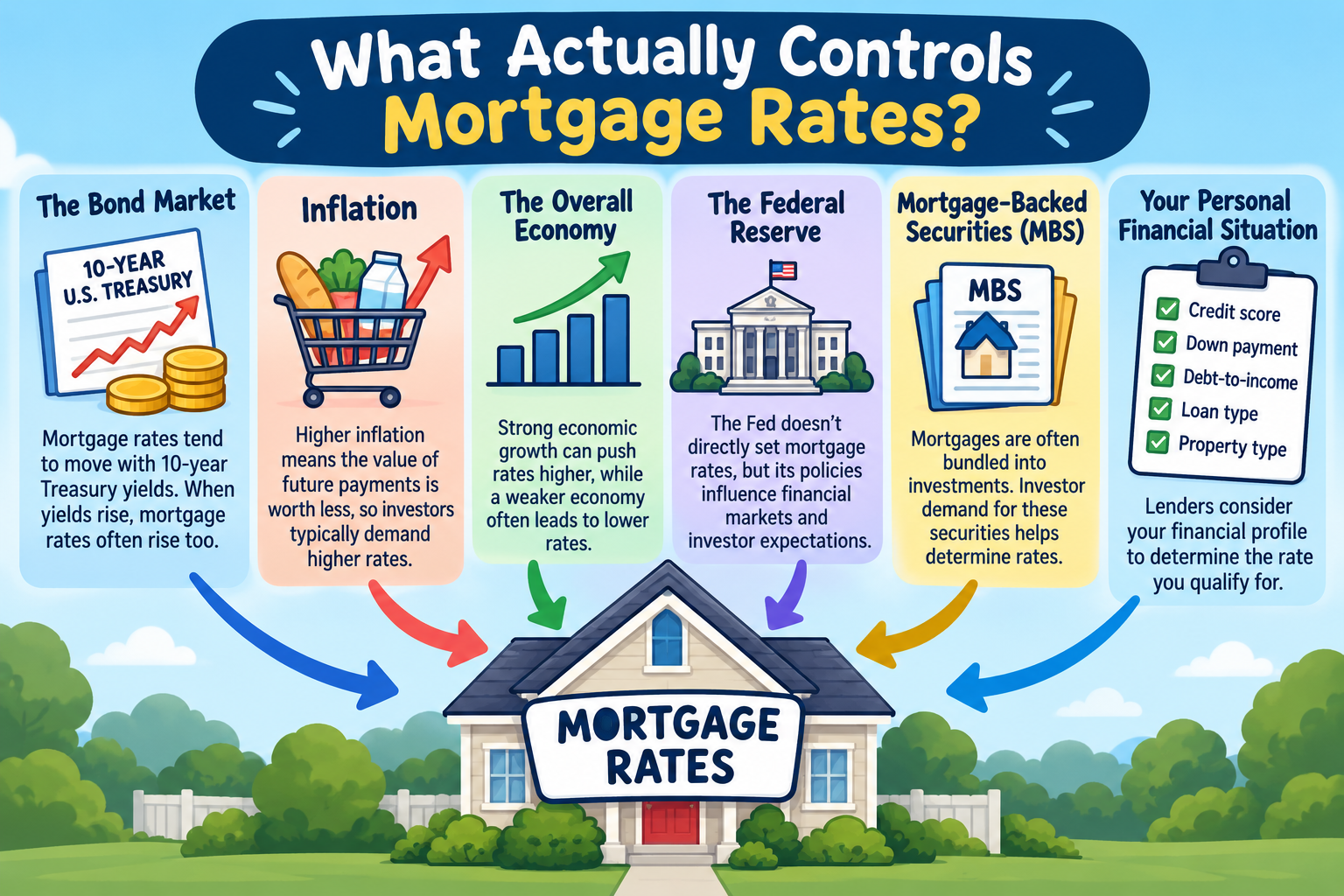
Instead, mortgage rates are influenced by a combination of the bond market, inflation, economic conditions, Federal Reserve policy, and the individual borrower.
1. The Bond Market Plays a Major Role
One of the biggest influences on mortgage rates is the bond market, particularly 10-year U.S. Treasury yields.
Mortgage rates and the 10-year Treasury yield don't move in perfect lockstep, but they tend to move in the same general direction.
Why?
Most homeowners don't keep the same mortgage for 30 years. They may sell, refinance, pay the loan off early, or move. Because of this, investors often compare mortgage-backed securities with other longer-term investments such as the 10-year Treasury.
When Treasury yields rise, mortgage rates will often rise as well. When yields fall, mortgage rates often follow.
2. Inflation Matters—a Lot
Inflation is one of the biggest enemies of low mortgage rates.
Imagine lending someone $500,000 at a fixed interest rate for 30 years. If inflation remains high, the dollars you're eventually paid back with are worth less than they were when you made the loan.
Investors therefore generally demand a higher return when they expect higher inflation.
Higher inflation expectations → pressure for higher mortgage rates
Lower inflation expectations → more opportunity for mortgage rates to decline
This is why reports about inflation can sometimes move mortgage rates quickly.
3. The Overall Economy Affects Rates
Mortgage rates also react to the strength of the U.S. economy.
Strong job growth, consumer spending and economic expansion can create upward pressure on rates—particularly if investors are concerned that a strong economy will keep inflation elevated.
On the other hand, signs of a slowing economy can cause investors to move money into safer investments such as Treasury bonds. That can push Treasury yields lower and potentially help mortgage rates decline.
In very simple terms, good economic news isn't always good news for mortgage rates.
4. The Federal Reserve Still Matters
Although the Fed doesn't directly set mortgage rates, its policies have enormous influence over financial markets.
When the Federal Reserve is concerned about inflation, it may keep short-term rates higher. When economic growth weakens or inflation becomes less of a concern, it may lower rates.
But mortgage markets are forward-looking.
Investors aren't simply asking, "What did the Fed do today?"
They're asking, "What is the Fed likely to do over the next six months, year or several years?"
That means anticipated Fed decisions may already be reflected in mortgage rates before an official announcement is made.
5. Mortgage-Backed Securities Also Affect Rates
After a mortgage is originated, it may eventually become part of a group of mortgages packaged together into an investment called a mortgage-backed security, or MBS.
Investors buy and sell these securities.
The price investors are willing to pay for mortgage-backed securities helps influence the rates lenders can offer borrowers. When investors want higher returns to compensate for inflation, economic uncertainty or other risks, mortgage rates can rise.
You don't need to understand the mechanics of mortgage-backed securities to buy a house—but it helps to know that mortgage rates are ultimately connected to a much larger investment market.
6. Your Personal Financial Situation Determines Your Rate
Two buyers purchasing similarly priced homes on the same day may receive different mortgage rates.
That's because lenders also consider the risk associated with each borrower and loan.
Your rate may be affected by factors such as:
- Credit score
- Down payment
- Loan amount
- Debt-to-income ratio
- Type of loan
- Property type
- Whether the home will be a primary residence, second home or investment property
- Length of the loan
- Whether you're paying discount points
This is why the mortgage rate you see advertised online isn't necessarily the rate you'll personally receive.
Why Do Mortgage Rates Change Every Day?
Mortgage rates are tied to financial markets, and those markets constantly react to new information.
Inflation reports, employment numbers, economic growth, geopolitical events, Federal Reserve announcements and investor sentiment can all affect bond yields and mortgage-backed securities.
As a result, mortgage rates can change from one day to the next—and sometimes even during the same day.
So, What Should Home Buyers Watch?
Rather than trying to predict exactly where rates will be next month, buyers should focus on the bigger financial picture.
A lower mortgage rate is certainly beneficial, but waiting for the "perfect" rate can have consequences if home prices rise, competition increases or the right property comes onto the market while you're sitting on the sidelines.
For example, a buyer may decide to wait because they hope rates will fall by 0.50%. But if rates decline and thousands of other buyers make the same decision to re-enter the market, increased competition could affect negotiating power and home prices.
There are a lot of moving pieces.
The Bottom Line
Mortgage rates aren't determined by one person, bank or government agency. They are the result of a much larger financial ecosystem.
Think of it this way:
Inflation + the economy + bond markets + Federal Reserve expectations + investor demand + your personal financial profile = the mortgage rate available to you.
For buyers, the goal doesn't necessarily need to be finding the lowest mortgage rate in history. The better question is whether purchasing a particular home at today's price, payment and financing terms makes sense for your finances and long-term goals.
And if rates eventually improve? Depending on the circumstances, refinancing may be an option.
Real estate decisions are rarely about one number. Understanding how the pieces work together can help you make a more informed decision about when—and how—to make your next move.
This information is provided for general educational purposes and is not intended as financial, lending, tax, or investment advice. Mortgage rates, loan programs, and qualification requirements vary by lender and borrower.

Lisa Ramos
Real Broker | Associate Broker | Lisa Ramos Homes | Real Broker
or another way